Wake Forest University
Patrick Edwin Moran
traditional:
å•�:「太極ä¸�是未有天地之先有箇渾æˆ�之物,是天地è�¬ç‰© 之ç�†ç¸½å��å�¦ï¼Ÿã€�曰:「太極å�ªæ˜¯å¤©åœ°è�¬ç‰©ä¹‹ç�†ã€‚在天地言 ,則天地ä¸æœ‰å¤ªæ¥µï¼›åœ¨è�¬ç‰©è¨€ï¼Œå‰‡è�¬ç‰©ä¸å�„有太極。未有 天地之先,畢竟是先有æ¤ç�†ã€‚動而生陽,亦å�ªæ˜¯ç�†ï¼›é�œè€Œ 生陰,亦å�ªæ˜¯ç�†ã€‚ã€�å•�:「太極解何以先動而後é�œï¼Œå…ˆç”¨ 而後體,先感而後寂?ã€�曰:「在陰陽言,則用在陽而體 在陰,然動é�œç„¡ç«¯ï¼Œé™°é™½ç„¡å§‹ï¼Œä¸�å�¯åˆ†å…ˆå¾Œã€‚今å�ªå°±èµ·è™• 言之,畢竟動å‰�å�ˆæ˜¯é�œï¼Œç”¨å‰�å�ˆæ˜¯é«”,感å‰�å�ˆæ˜¯å¯‚,陽å‰� å�ˆæ˜¯é™°ï¼Œè€Œå¯‚å‰�å�ˆæ˜¯æ„Ÿï¼Œé�œå‰�å�ˆæ˜¯å‹•ï¼Œå°‡ä½•è€…為先後?ä¸� å�¯å�ªé�“今日動便為始,而昨日é�œæ›´ä¸�說也。如鼻æ�¯ï¼Œè¨€å‘¼ å�¸å‰‡è¾é †ï¼Œä¸�å�¯é�“å�¸å‘¼ã€‚畢竟呼å‰�å�ˆæ˜¯å�¸ï¼Œå�¸å‰�å�ˆæ˜¯å‘¼ã€‚ ã€�
淳。
simplified:
问:「太æž�ä¸�是未有天地之先有个浑æˆ�之物,是天地万物 之ç�†æ€»å��å�¦ï¼Ÿã€�曰:「太æž�å�ªæ˜¯å¤©åœ°ä¸‡ç‰©ä¹‹ç�†ã€‚在天地言 ,则天地ä¸æœ‰å¤ªæž�;在万物言,则万物ä¸å�„有太æž�。未有 天地之先,毕竟是先有æ¤ç�†ã€‚动而生阳,亦å�ªæ˜¯ç�†ï¼›é�™è€Œ 生阴,亦å�ªæ˜¯ç�†ã€‚ã€�问:「太æž�解何以先动而後é�™ï¼Œå…ˆç”¨ 而後体,先感而後寂?ã€�曰:「在阴阳言,则用在阳而体 在阴,然动é�™æ— ç«¯ï¼Œé˜´é˜³æ— å§‹ï¼Œä¸�å�¯åˆ†å…ˆå¾Œã€‚今å�ªå°±èµ·å¤„ 言之,毕竟动å‰�å�ˆæ˜¯é�™ï¼Œç”¨å‰�å�ˆæ˜¯ä½“,感å‰�å�ˆæ˜¯å¯‚,阳å‰� å�ˆæ˜¯é˜´ï¼Œè€Œå¯‚å‰�å�ˆæ˜¯æ„Ÿï¼Œé�™å‰�å�ˆæ˜¯åŠ¨ï¼Œå°†ä½•è€…为先後?ä¸� å�¯å�ªé�“今日动便为始,而昨日é�™æ›´ä¸�说也。如鼻æ�¯ï¼Œè¨€å‘¼ å�¸åˆ™è¾žé¡ºï¼Œä¸�å�¯é�“å�¸å‘¼ã€‚毕竟呼å‰�å�ˆæ˜¯å�¸ï¼Œå�¸å‰�å�ˆæ˜¯å‘¼ã€‚ ã€�
淳。
big5:
¡u¤Ó·¥¤£¬O¥¼¦³¤Ñ¦a¤§¥ý¦³ºç´ý¦¨¤§ª«¡A¬O¤Ñ¦a¸Uª« ¤§²zÁ`¦W§_¡H¡v¤ê¡G¡u¤Ó·¥¥u¬O¤Ñ¦a¸Uª«¤§²z¡C¦b¤Ñ¦a¨¥ ¡A«h¤Ñ¦a¤¤¦³¤Ó·¥¡F¦b¸Uª«¨¥¡A«h¸Uª«¤¤¦U¦³¤Ó·¥¡C¥¼¦³
¤Ñ¦a¤§¥ý¡A²¦³º¬O¥ý¦³¦¹²z¡C°Ê¦Ó¥Í¶§¡A¥ç¥u¬O²z¡FÀR¦Ó ¥Í³±¡A¥ç¥u¬O²z¡C¡v°Ý¡G¡u¤Ó·¥¸Ñ¦ó¥H¥ý°Ê¦Ó«áÀR¡A¥ý¥Î ¦Ó«áÅé¡A¥ý·P¦Ó«á±I¡H¡v¤ê¡G¡u¦b³±¶§¨¥¡A«h¥Î¦b¶§¦ÓÅé ¦b³±¡AµM°ÊÀRµLºÝ¡A³±¶§µL©l¡A¤£¥i¤À¥ý«á¡C¤µ¥u´N°_³B ¨¥¤§¡A²¦³º°Ê«e¤S¬OÀR¡A¥Î«e¤S¬OÅé¡A·P«e¤S¬O±I¡A¶§«e ¤S¬O³±¡A¦Ó±I«e¤S¬O·P¡AÀR«e¤S¬O°Ê¡A±N¦óªÌ¬°¥ý«á¡H¤£ ¥i¥u¹D¤µ¤é°Ê«K¬°©l¡A¦Ó¬Q¤éÀR§ó¤£»¡¤]¡C¦p»ó®§¡A¨¥©I§l«hÃ㶶¡A¤£¥i¹D§l©I¡C²¦³º©I«e¤S¬O§l¡A§l«e¤S¬O©I¡C
¡v
²E¡C
GB:
ÎÊ£º¡¸Ì«¼«²»ÊÇδÓÐÌìµØÖ®ÏÈÓиö»ë³ÉÖ®ÎÊÇÌìµØÍòÎï Ö®Àí×ÜÃû·ñ£¿¡¹Ô»£º¡¸Ì«¼«Ö»ÊÇÌìµØÍòÎïÖ®Àí¡£ÔÚÌìµØÑÔ £¬ÔòÌìµØÖÐÓÐÌ«¼«£»ÔÚÍòÎïÑÔ£¬ÔòÍòÎïÖи÷ÓÐÌ«¼«¡£Î´ÓÐ ÌìµØÖ®ÏÈ£¬±Ï¾¹ÊÇÏÈÓдËÀí¡£¶¯¶øÉúÑô£¬ÒàÖ»ÊÇÀí£»¾²¶ø ÉúÒõ£¬ÒàÖ»ÊÇÀí¡£¡¹ÎÊ£º¡¸Ì«¼«½âºÎÒÔÏȶ¯¶øáá¾²£¬ÏÈÓà ¶øááÌ壬Ïȸжøáá¼Å£¿¡¹Ô»£º¡¸ÔÚÒõÑôÑÔ£¬ÔòÓÃÔÚÑô¶øÌå ÔÚÒõ£¬È»¶¯¾²Î޶ˣ¬ÒõÑôÎÞʼ£¬²»¿É·ÖÏÈáá¡£½ñÖ»¾ÍÆð´¦ ÑÔÖ®£¬±Ï¾¹¶¯Ç°ÓÖÊǾ²£¬ÓÃÇ°ÓÖÊÇÌ壬¸ÐÇ°ÓÖÊǼţ¬ÑôÇ° ÓÖÊÇÒõ£¬¶ø¼ÅÇ°ÓÖÊǸУ¬¾²Ç°ÓÖÊǶ¯£¬½«ºÎÕßΪÏÈá᣿²» ¿ÉÖ»µÀ½ñÈÕ¶¯±ãΪʼ£¬¶ø×òÈÕ¾²¸ü²»ËµÒ²¡£Èç±ÇÏ¢£¬ÑÔºô ÎüÔò´Ç˳£¬²»¿ÉµÀÎüºô¡£±Ï¾¹ºôÇ°ÓÖÊÇÎü£¬ÎüÇ°ÓÖÊǺô¡£ ¡¹
´¾¡£
Text from Wesleyan e-text project, checked against Zhu Zi Yu-lei Da-quan text.
[Someone] asked: "Isn't Tai-ji the general name for a diffuse being that existed before there was a heaven and earth and that was the li of heaven, earth, and the myriad creatures?" [Zhu Xi] said: "Tai-ji is just the Li of heaven, earth, and the myriad creatures. Speaking with regard to heaven and earth, then within them there is [naturally] the Tai-ji. Speaking with regard to the myriad creatures, then within them there is the Tai-ji in each of them. In the final analysis, before there was either heaven or earth there was first this Li. In moving it produces Yang and yet is just a Li. In being still it produces Yin and yet is just a Li." [Someone] asked: In the explanation of the Tai-ji [Diagram], why does it mention movement (action) before stillness (inaction)? First function and then basis for function? First reaction and then silence (i.e., the silence in the heart from which all reactions come)?" [Zhu Xi] said: "Speaking in terms of Yin and Yang, the function lies with Yang and the basis for function lies with Yin. However, (alternations between) movement and stillness are without end, and Yin and Yang (alternations) are without a beginning. [So] it is impossible to differentiation between former and latter. For the moment I will address myself to the point of origination to speak of it. In the final analysis, before movement there is stillness, before function there is basis for function, before psychological reaction there is silence, before Yang there is Yin, yet before silence there is psychological reaction, and before stillness there is movement. What should be taken as prior and what as posterior? One cannot simply say that today's movement is taken to be the beginning and neglect to mention the stillness that was there yesterday. Take breathing for instance, if we say "hu xi" (exhale-inhale) then it sounds right; we can't say "xi-hu" (inhale-exhale) [because that sounds wrong to us]. [But] in the final analysis, before exhalation there in inhalation and before inhalation there is inhalation." [Recorded by the disciple Chun]
Commentary:
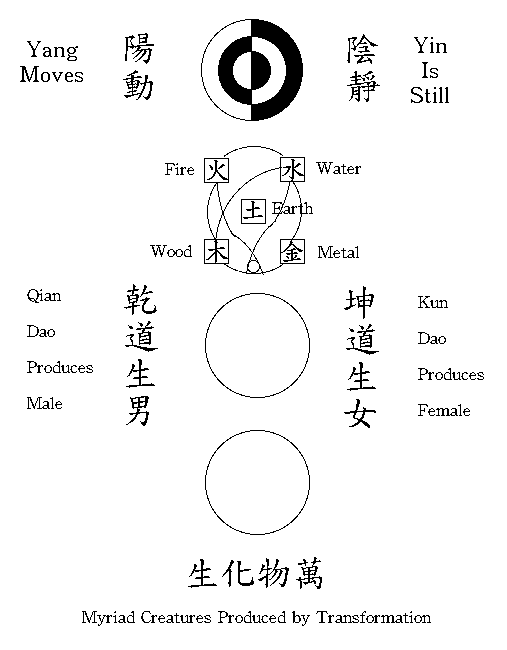
It is very difficult to know where in Zhu Xi's writing one should begin reading about the philosophical issues mentioned in the conversation recorded here. Since this passage is the first one in the Zhu Zi Yu-lei (Classified conversations of Master Zhu), I will begin translating and explaining here. But the reader should understand that this is a fairly arbitrary point at which to begin study. Terms such as "Tai-ji," "yin," "yang," etc. trace back to the Yi Jing (Book of Changes). Sometimes it is difficult to determine whether Zhu Xi is talking about matters solely relevant to the trigrams and hexagrams of the Yi Jing, and when he is talking about metaphysical questions. The general context established in this passage makes it clear that Zhu Xi is talking about metaphysical questions. The term Tai-ji is related to heaven, earth, and either to each of the myriad creatures individually or to them collectively as their li. But what is the nature of this relationship? When Zhu Xi says, "Tai-ji is just the Li of heaven, earth, and the myriad creatures," how are we supposed to understand this statement? The Tai-ji is presumably a unity, so how can it pertain to three different things, or three fundamentally different kinds of things one of which itself includes a vast number of individuals? Is it a component, a quality, a source, or what? Is it analogous to mass, to whatever existed before the Big Bang, to energy, to organization? Or what? It is said to be a li, but what does that mean? If this li is what we would call a "principle," what does it mean to say that a principle moves or is still? And what could it mean to say that a single principle is "in" each of the myriad creatures? If the "principle" is what accounts for the characteristics of each thing, then how could the same principle produce a multitude of things each with different characteristics? If the Tai-ji or if Li can be called the reason that things are as they are, then why does the same principle act as the reason for the existence and/or the characteristics of a multitude of different concrete entities of different kinds? And what does the cyclical characteristics of Yin and Yang, the one producing the other in an infinite series of alternations, have to do with any of this? To say that the Tai-ji or Li is like Platonic Ideas or Aristotelian forms prejudges too much and invites us to bring too many preconceptions into our consideration of a system of thought that originally had no connection with Greek philosophy other than that the Chinese and the Greeks were trying to explain the same universe to themselves. Yet we need some kind of initial hypothesis that will help us to organize our thoughts and direct our investigations. Therefore I propose to say of what Zhu Xi calls either the Tai-ji or the Li that it is the reason that things are as they are. By saying that Zhu Xi is talking about an ultimate reason here is not to suggest anything very specific at this point. All that I want to suggest is that Zhu Xi is trying to point out that the existence and characteristics of things are not arbitrary. I want to use "reason" in the sense we use it when we say something like, "The reason he is angry is that someone broke all the windows of his car." Now we can take one further step: Where does Zhu Xi appear to be looking for explanatory generalizations to use in forming an understanding of why things are as they are? The terms used in the text above, Tai-ji, Yin, and Yang, are all from the Yi Jing (Book of Changes). The confusing thing is that the Yi Jing proper (i.e., the book minus the early commentaries that have traditionally been printed together with the original corpus) is a book of divination -- or, in the words of the book itself, it is a book that is intended to help people resolve uncertainties. The Yi Jing proper is a collection of indications that are keyed to the 64 hexagrams, and the 64 hexagrams are figures formed on the basis of a series of manipulations of 50 stalks of milfoil (yarrow). Each of the 64 hexagrams is a patterns of broken and unbroken lines respresenting gang (yang) and rou (yin), or, in Western terms, hardness and softness. The basic meaning of "li" is "pattern," so there is at least some conjectural basis for suggesting that the li of the things of the world are somehow similar to or connected to the patterns drawn as the hexagrams. We can further note that here Zhu Xi seems to picture the Li that corresponds to (or is another name for) the Tai-ji as a single entity that gives us the reason for the multiplicity characteristic of our phenomenal world. He further asserts that this "reason" can "move" or "be still." It is very hard to imagine a Platonic Idea or an Aristotelian form moving, so we can be fairly sure that we are in completely new territory here. Zhu Xi's student asks this kind of question: "Why does the 'Tai-ji Diagram' mention the sound of flute playing (the function) and then the flute (the basis of function)?" Zhu Xi says that (at least in the metaphysical domain) the act and the actor are in ceaseless alternation. The "music" constitutes the next "flute," and that "flute" constitutes the next "music." This alternation is dependent, somehow, on the "movement" of the Tai-ji. In the most general, most unprejudicial terms, we can come up with, Zhu Xi seems to affirm that there is something that stands as the reason for the existence and characteristics of the things of the world. This reason "moves" and produces Yang and then "rests" and produces Yin. Yin and yang go on in ceaseless alternation, which process is apparently driven by the movement and rest of the "reason" for the world. The Yin-Yang alternation process seems to be posited to explain the more specific phenomena of this world. This conversation pertains to the schema called the Zhou Zi Tai-ji Tu (Master Zhou [Dun-yi]'s Tai-ji Diagram), which I take to be a flow chart of the creation of the universe and the things found in it. That chart has several levels which I take to be the Tai-ji (something like whatever was "before" the Big Bang, and from which came time and all beings), then Yin and Yang, the metaphysical "five elements" (five phases of being), then the sequences possible among those five phases, the "forward" sequence corresponding to what we experience in daily life as the celestial sphere and the "reverse" sequence corresponding to what we call the earth, and finally, growing out of all of the above underlying levels, the myriad creatures. To see the Tai-ji Tu, click here To see the entire Wesleyan Chinese text of the first chapter of the Zhu Zi Yu-lei, click here .
-- PEM
This conversation was recorded by Chen Chun, who studied with Zhu Xi from 1190-1191 and again from 1199-1200.