
With Katherine Slyman, Mackenzie Simper, and Björn Sandstede, I studied how the geometry of a most probable noise-induced escape changes when a gradient system is perturbed by a small nongradient vector field. Gradient systems are unusually tractable: the optimal escape trajectory is simply the time reversal of a deterministic heteroclinic orbit. The central question is how robust this fact is when the deterministic dynamics are only approximately gradient.
Stochastic exit problem
We consider
\[ dX_t=f(X_t)\,dt+\epsilon\,dW_t, \qquad 0<\epsilon\ll1, \]with an asymptotically stable equilibrium \(a\) and domain of attraction \(\mathcal A\). For an absolutely continuous path \(u\), the Freidlin–Wentzell action is
\[ \mathcal I(u)=\frac12\int_{T_0}^{T_1}|\dot u-f(u)|^2\,dt, \]and the quasi-potential of a boundary point \(z\in\partial\mathcal A\) is
\[ \mathcal V(z)=\inf\{\mathcal I(u):u(T_0)=a,\ u(T_1)=z\}. \]The minimizer of \(\mathcal V\) on \(\partial\mathcal A\) determines the most probable exit location, while the minimizing path gives the leading-order geometry of a rare escape.
Gradient systems
If \(f=-\nabla V\), then an escape through a saddle \(b\) follows the time reversal of the heteroclinic orbit \(q\) satisfying
\[ \dot q=-\nabla V(q),\qquad q(-\infty)=b,\quad q(+\infty)=a. \]Consequently the most probable escape is \(u_*(t)=q(-t)\). This gives a rare example where the variational problem can be read directly from the deterministic phase portrait.
Nongradient perturbations
We perturb the dynamics according to
\[ \dot x=-\nabla V(x)+\mu g(x),\qquad |\mu|\ll1. \]When \(g\) is itself a gradient perturbation, the time-reversed heteroclinic structure persists. For a genuinely nongradient perturbation, however, the optimal path and the reversed deterministic connection generally separate at order \(\mu\). The relevant obstruction is encoded by the antisymmetric part of the Jacobian,
\[ \big(Dg(q(t))-Dg(q(t))^{T}\big)\dot q(t). \]If this quantity is not identically zero along the unperturbed connection, the most probable escape is displaced from the time-reversed deterministic orbit.
Hamiltonian and Melnikov viewpoint
The Euler–Lagrange equation associated with the action can be written as a Hamiltonian system. Both the deterministic heteroclinic and the optimal escape path become heteroclinic orbits in related systems. This makes Melnikov theory a natural tool: one expands the stable and unstable manifolds in \(\mu\), compares the resulting splitting, and determines when the two heteroclinic connections cease to coincide.
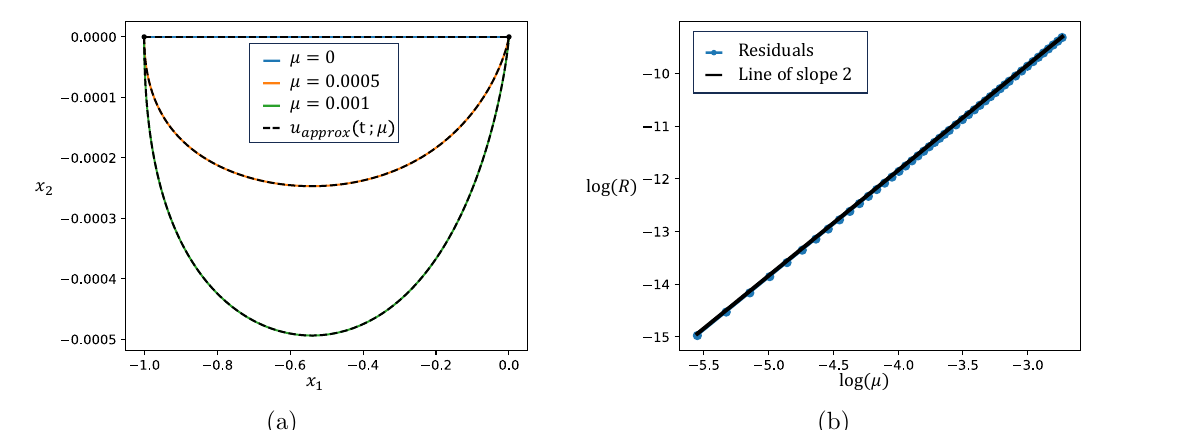
For the examples in the paper we obtain asymptotic approximations of the form
\[ u_*(t;\mu)=u_0(t)+\mu u_1(t)+\mathcal O(\mu^2), \]and numerical calculations verify the predicted quadratic residual after the first-order correction. The figure compares the perturbed optimal path with its asymptotic approximation and shows the predicted quadratic scaling of the residual.
\[\dot x=-\nabla V(x)+\mu g(x),\qquad |\mu|\ll1,\]\[dX_t=\bigl[-\nabla V(X_t)+\mu g(X_t)\bigr]dt+\varepsilon\,dW_t.\]\[\mathcal I[u]=\frac12\int_{T_0}^{T_1}\left|\dot u+\nabla V(u)-\mu g(u)\right|^2dt.\]Reference
- Slyman, K., Simper, M., Gemmer, J. A., & Sandstede, B. (2025). Most Probable Escape Paths in Perturbed Gradient Systems. SIAM Journal on Applied Dynamical Systems 24(2), 1408–1421.