
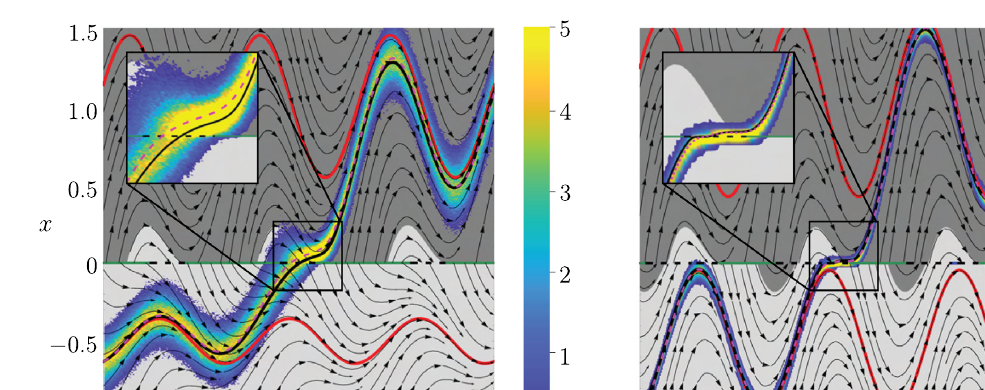
With Kaitlin Hill and Jessica Zanetell, I developed a variational framework for most probable transition paths in stochastic differential equations whose drift is only piecewise smooth. Such systems arise whenever different dynamical laws act on opposite sides of a threshold or switching surface. The main difficulty is that the standard Freidlin–Wentzell action is formulated for smooth drift fields, while a transition in a piecewise-smooth system may cross or even spend positive time on the switching manifold. The first image below compares the transition density obtained from Monte Carlo simulations with the variationally computed most probable path, illustrating how the stochastic transition trajectories concentrate around the predicted minimizer.
The piecewise-smooth SDE
We consider stochastic differential equations of the form
\[ dX_t=F(X_t,t)\,dt+\sigma\,dW_t, \]with a drift that changes across a switching manifold. In two dimensions, after choosing coordinates so that the switch is \(\Sigma=\{x=0\}\), one may write
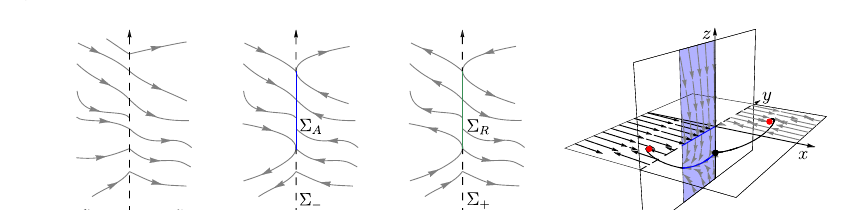
\[ F(x,y,t)= \begin{cases} F^+(x,y,t),&x>0,\\[3pt] F^-(x,y,t),&x<0. \end{cases} \]The deterministic dynamics near \(\Sigma\) depend on the normal components \(F_1^+\) and \(F_1^-\). If they point through the manifold in the same direction, trajectories cross the switch. If they point toward one another, the system has attracting sliding; if they point away from one another, it has repelling sliding. The second image illustrates these possible switching geometries, showing examples of crossing, attracting sliding, and repelling sliding, together with a piecewise-smooth Lorenz example. These distinct deterministic behaviors at the switching manifold are important because they lead to different structures for the corresponding noise-induced transition paths.
Filippov sliding
On a sliding portion of the switching manifold, the classical Filippov construction uses a convex combination
\[ F^s(0,y)=\lambda(y)F^+(0,y)+(1-\lambda(y))F^-(0,y), \]where \(\lambda\) is chosen so that the normal component vanishes. Thus
\[ \lambda(y)=\frac{F_1^-(0,y)}{F_1^-(0,y)-F_1^+(0,y)}. \]This produces a vector field tangent to \(\Sigma\). One of the appealing features of the stochastic variational theory is that the same convex combination emerges from the limiting rate functional rather than having to be imposed separately.
The Freidlin–Wentzell action
For a smooth drift, rare transitions between metastable states are governed, in the small-noise limit, by minimizers of the Freidlin–Wentzell action. With the normalization used in this work, the action has the schematic form
\[ I[\alpha]=\int_{t_0}^{t_f}\|\dot\alpha(t)-F(\alpha(t),t)\|^2\,dt. \]It vanishes on deterministic trajectories and penalizes deviations from the deterministic flow. At a discontinuity, however, the value of \(F\) is ambiguous and a minimizing path may interact nontrivially with \(\Sigma\). This is precisely where the smooth theory has to be modified.
Mollification and \(\Gamma\)-convergence
We first replace the discontinuous vector field by a smooth family \(F_\varepsilon\) obtained by mollifying the drift across a layer of thickness \(\varepsilon\). Each smooth problem has an ordinary Freidlin–Wentzell functional \(I_\varepsilon\). We then determine the variational limit as \(\varepsilon\to0\) using \(\Gamma\)-convergence.
If \(\alpha=(\alpha_1,\beta)\), with \(\alpha_1\) normal to the switching manifold, the limiting functional separates the portions of the path away from and on the switch:
\[ \bar I[\alpha] = \int_{\{t:\alpha_1(t)\neq0\}} \|\dot\alpha-F(\alpha,t)\|^2\,dt + \int_{\{t:\alpha_1(t)=0\}} \min_{\lambda\in[0,1]} \left\|\dot\alpha-\lambda F^+-(1-\lambda)F^-\right\|^2\,dt. \]The first term is the familiar Freidlin–Wentzell cost. The second is the additional surface contribution created by the discontinuity. When a path follows the appropriate Filippov sliding velocity, the surface term can vanish. In crossing or repelling configurations, remaining on the switch can carry a positive variational cost.
Non-uniqueness and sliding transitions
The limiting action explains several phenomena that do not arise in the same way for smooth gradient systems. In particular, a repelling sliding region can generate families of minimizers with the same leading-order action. The deterministic dynamics alone therefore need not select a unique most probable transition path. Finite-noise Monte Carlo simulations can concentrate near one member of this family, revealing information that is invisible at leading Freidlin–Wentzell order.
Periodically forced case study
One of our examples is a scalar periodically forced system whose drift is linear on each side of the switch:
\[ f^+(x,t)=-r_+(x-1)+A_+\cos(2\pi t), \qquad f^-(x,t)=-r_-(x-a)+A_-\cos\bigl(2\pi(t-p)\bigr). \]Each half-system has a periodic response, and the switching manifold separates basins associated with different attracting periodic states. The published figure compares the transition density produced by Monte Carlo simulation with variationally predicted most-probable paths. In parameter regimes with attracting sliding, the stochastic paths can track the switching manifold. In repelling regimes, the leading-order variational problem may admit non-unique sliding minimizers even though the simulated transition ensemble concentrates near a particular crossing path.
Why this framework is useful
The main result is not tied to one application. It provides a systematic way to study noise-induced transitions in systems with thresholds, switches, and nonsmooth constitutive laws. The framework also clarifies the relationship between stochastic large-deviation theory and deterministic Filippov dynamics: sliding appears as part of the variational limit itself.
Reference
- Hill, K., Zanetell, J., & Gemmer, J. A. (2022). Most probable transition paths in piecewise-smooth stochastic differential equations. Physica D: Nonlinear Phenomena 439, 133424.