
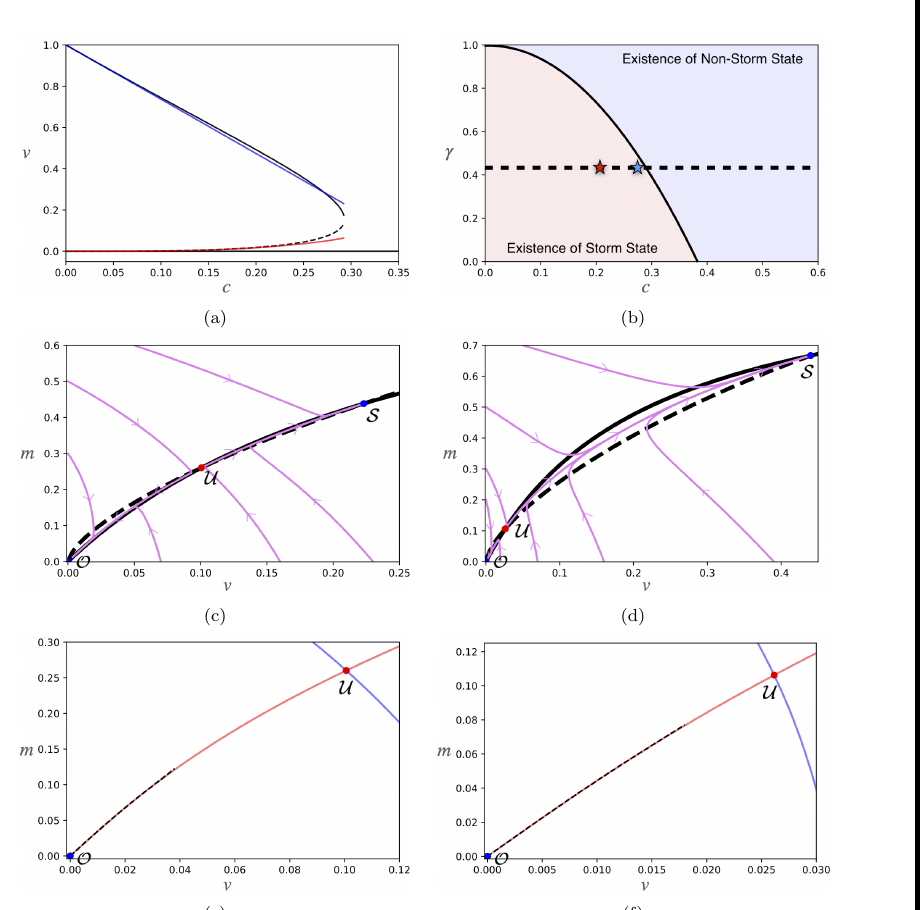
With Katherine Slyman, Nicholas Corak, Claire Kiers, and Chris Jones, I studied how several different tipping mechanisms arise in a low-dimensional dynamical model for tropical-cyclone formation. The model, originally motivated by work of Kerry Emanuel, couples the tangential wind speed in the eyewall to the moisture available in the storm's inner core. Despite having only two state variables, it contains a stable non-storm state, an unstable storm state, and—over a physically relevant parameter range—a stable active-storm state. This makes it a useful setting for separating bifurcation-induced, rate-induced, and noise-induced transitions.
The deterministic model
After nondimensionalization, the state variables are the normalized wind speed \(v\) and inner-core moisture \(m\). The governing equations are
\[ \frac{dv}{d\tau}=(1-\gamma)m^3-(1-\gamma m^3)v^2, \qquad \frac{dm}{d\tau}=(1-m)v-cm, \]where \(\gamma\in(0,1)\) measures thermodynamic effects and \(c=2.2S/V_p\) is a dimensionless wind-shear parameter. The physically relevant phase space is \([0,1]\times[0,1]\), which is forward invariant. Fixed points satisfy
\[ m=\frac{v}{v+c},\qquad v^2p(v)=0, \]with
\[ p(v)=(1-\gamma)v+\gamma v^3-(v+c)^3. \]The origin \(\mathcal O=(0,0)\) is the non-storm equilibrium. For sufficiently small wind shear, two additional equilibria appear: an unstable saddle \(\mathcal U\) and a stable storm state \(\mathcal S\). The bifurcation diagram and phase portraits show how these equilibria organize the basins of attraction and create the geometric setting in which tipping can occur.
Rate-induced tipping
To study environmental change, we allow parameters such as wind shear and maximum potential velocity to vary in time. If \(\lambda(rt)\) denotes a parameter ramp with rate \(r\), the resulting nonautonomous system has the schematic form
\[ \dot{x}=F(x,\lambda(rt)),\qquad x=(v,m). \]Rate-induced tipping occurs when the parameter changes rapidly enough that a trajectory can no longer track the moving storm equilibrium and instead crosses a basin boundary. A notable feature of this model is that rate-induced tipping alone cannot create a storm from \(\mathcal O\): the non-storm equilibrium remains fixed as the parameters change. In contrast, a sufficiently rapid simultaneous increase in wind shear and maximum potential velocity can destabilize an existing storm. The second requirement is counterintuitive and illustrates how rate tipping can depend on the geometry of moving basins rather than simply on the instantaneous stability of equilibria.
Noise-induced transitions and large deviations
We next add independent stochastic forcing to the wind-speed and moisture equations,
\[ dX_\tau=F(X_\tau)\,d\tau+B\,dW_\tau, \qquad B=\begin{pmatrix}\sigma_1&0\\0&\sigma_2\end{pmatrix}. \]For small noise, Freidlin–Wentzell theory predicts that transition paths concentrate near minimizers of the action
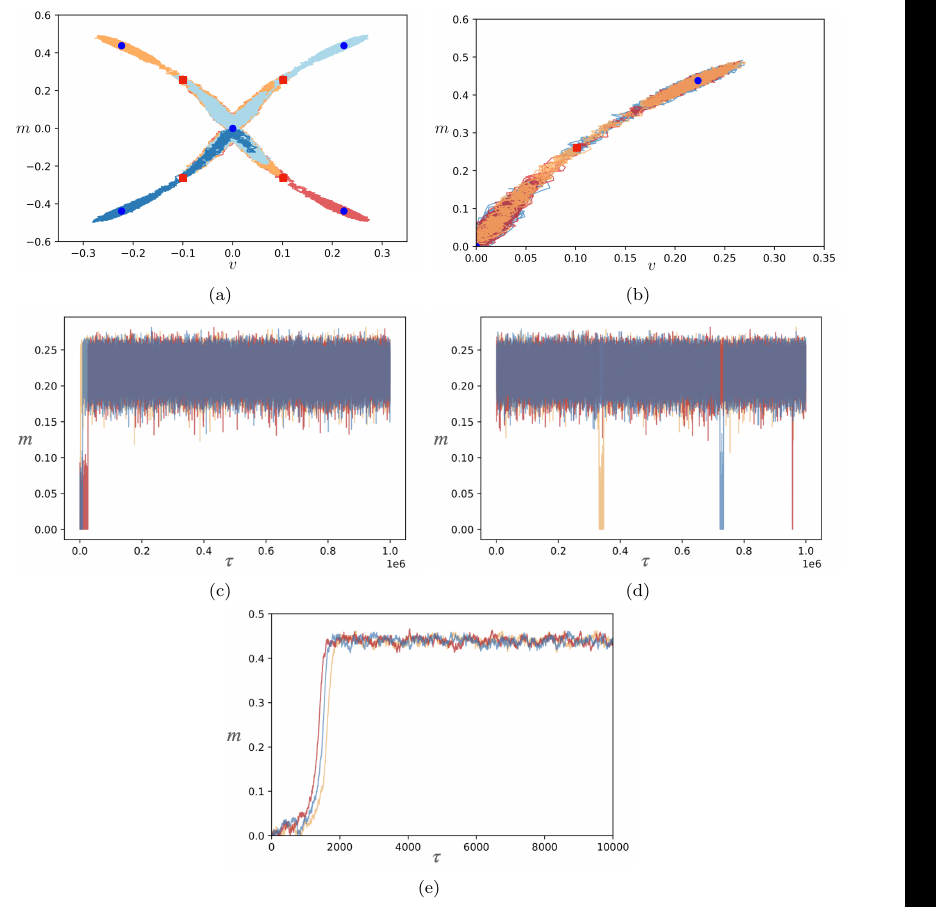
\[ I[\Psi]=\frac12\int_{\tau_0}^{\tau_f} \|\dot\Psi-F(\Psi)\|_{\Sigma}^{2}\,d\tau, \qquad \Sigma=\begin{pmatrix}\sigma_1^{-2}&0\\0&\sigma_2^{-2}\end{pmatrix}. \]Thus the most probable path from \(\mathcal O\) to \(\mathcal S\) is obtained by solving a variational problem rather than by simply following the deterministic flow backward. The stochastic calculations show a strong asymmetry: the non-storm state is much more susceptible to noise-induced activation than the stable storm state is to noise-induced collapse.
Interpretation
The model separates two physically distinct mechanisms. Rapid environmental change is primarily a mechanism for storm destabilization, whereas stochastic fluctuations are capable of both forming and destroying storms and are particularly effective at activating a storm from the non-storm state. The combination of bifurcation analysis, nonautonomous dynamics, and large-deviation theory provides a mathematical framework for understanding why these different tipping mechanisms need not be interchangeable.
\[\frac{dv}{d\tau}=(1-\gamma)m^3-(1-\gamma m^3)v^2,\qquad \frac{dm}{d\tau}=(1-m)v-Cm,\]\[dX_t=f(X_t)dt+\varepsilon\,dW_t,\]\[I[\phi]=\frac12\int_{t_0}^{t_f}\|\dot\phi-f(\phi)\|^2dt.\]Reference
- Slyman, K., Gemmer, J. A., Corak, N. K., Kiers, C., & Jones, C. K. R. T. (2024). Tipping in a low-dimensional model of a tropical cyclone. Physica D: Nonlinear Phenomena 457, 133969.